

This course is an introductory exposition of topics drawn from the Pramāna tradition, based on the Classifications of Mind root text. Students explore the criteria for the validity of cognition, the fourfold classification of direct valid cognition, seeming direct cognition and non-valid cognition.

This course completes the introductory exposition of topics drawn from the Pramāna and Abhidhama traditions, based on the Classifications of Mind and Collected Topics root texts. It provides students with the tools for delineating conceptual and non-conceptual mind in meditation, known as the essential modes of engagement of mind.

This course is an exposition of the Tathāgatagarbha philosophical tradition, based on the The Mahayana Uttaratantra Shastra: Fourth Vajra Point root text. Students cultivate certainty in the view of Buddha nature—the essence of awakening present in all beings. The Fourth Vajra Point of the Uttaratantra establishes Buddha nature through three reasonings, its ten aspects, nine analogies and five reasons why it is necessary to teach it.

This course is the continuation of an in-depth study of Treasury of Valid Cognition and Reasoning, (tshad ma rigs gter) by renowned scholar Sakya Pandita (1182-1251) – an influential work that inaugurated a new period of pramana studies in Tibet by focusing particularly on Dharmakirti’s Pramanavarttika and identifying the errors of earlier Tibetan scholars, especially Chapa Chökyi Senge. We will study Sakya Pandita’s seminal work on the basis of the commentary by Jamyang Loter Wangpo (1847-1914).
This fall 2026, Acharya Kelzang Wangdi will continue teaching chapter 9 on direct perception (mngon sum). When that is complete, he will turn to chapter 10 on inference for oneself (rang don rjes su dpag pa).

This course explores the question: How do you obtain accurate and valid knowledge about the world? That's the subject of pramana, or Buddhist epistemology. We typically assume that what we know about the world is valid. But is it? Our mind processes information so quickly, it responds so fast to what's happening around us that we usually don't realize when we are having a conceptual experience that is not actually in agreement with the object that we are experiencing.
This course is an introductory exposition of topics drawn from the Pram?na tradition, based on the Classifications of Mind root text. Students explore the criteria for the validity of cognition, the fourfold classification of direct valid cognition, seeming direct cognition and non-valid cognition.
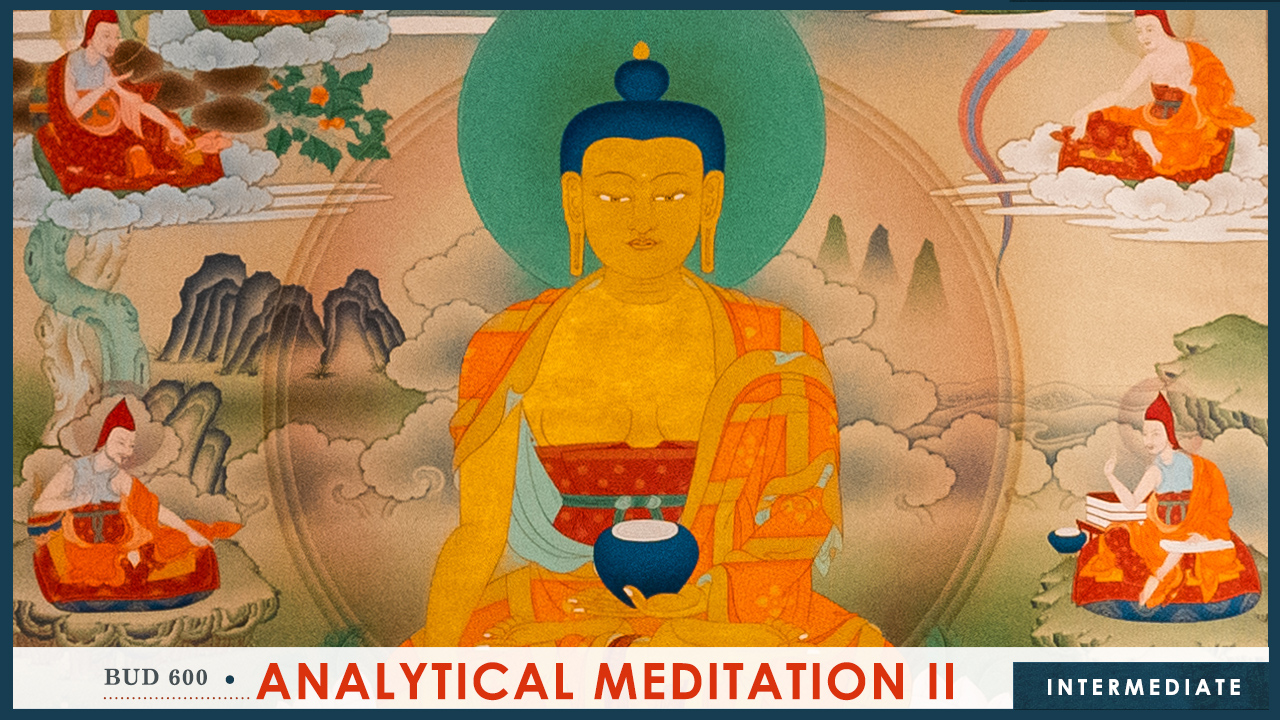
This course is a systematic training in the meditation of special insight in the tradition of Mahayana Buddhism. The students learn the skills to gain certainty in the view of emptiness through the practice of the Four Mah?y?na Yogas, cultivating inferential wisdom and bringing it to personal experience.